
Our Services
Contact
6300 South Syracuse Way , Suite 150 , Centennial CO 80111 (303) 351-2014 Bob@EngelPropertyGroup.comDo you want content like this delivered to your inbox?
Forget Waiting for Mortgage Rates to Fall: Thousands of Colorado Homes May Already Have a 2%–5% Mortgage Attached

Bob Engel
As a real estate professional with over thirty-five years of national real estate experience, Bob has the strong industry knowledge rarely found in re...
As a real estate professional with over thirty-five years of national real estate experience, Bob has the strong industry knowledge rarely found in re...
What if the solution to today's high mortgage rates isn't waiting for rates to fall—but buying a home that already has a dramatically lower mortgage attached to it?
For the last several years, prospective homebuyers have been hearing essentially the same advice: “Wait for mortgage rates to come down.” There's just one problem. Nobody knows exactly when that will happen. And while buyers wait, home prices can change, inventory can change, their personal circumstances can change—and when mortgage rates eventually decline meaningfully, thousands of other sidelined buyers may return to the market at exactly the same time.
But there's another strategy receiving surprisingly little attention. Instead of waiting for a future mortgage rate you hope will arrive, what if you could take over a mortgage that already exists at 2%, 3%, 4% or 5%? In certain circumstances, you can. Welcome to the world of the assumable mortgage, an often-overlooked financing opportunity that could dramatically change the economics of buying a home in today's Colorado housing market.
WHAT EXACTLY IS AN ASSUMABLE MORTGAGE?
An assumable mortgage allows a qualified purchaser to take over the seller's existing mortgage rather than replacing it with an entirely new first mortgage at today's interest rate. That means the buyer potentially steps into the seller's existing interest rate, remaining loan balance and repayment term. This matters because millions of Americans purchased or refinanced homes during the extraordinarily low-interest-rate period of 2020–2022. Some secured 30-year mortgage rates around 3%, while others were even lower. Those mortgages didn't disappear when interest rates increased. They're still attached to the homes, and some can potentially be transferred to the next qualified owner.
NOT EVERY MORTGAGE CAN BE ASSUMED
Most conventional mortgages are generally not freely assumable because they contain due-on-sale provisions requiring repayment when ownership changes. However, certain government-backed mortgages operate differently, creating opportunities that many buyers don't realize exist.
FHA Loans: FHA-insured mortgages are generally assumable by a qualified purchaser, subject to FHA and loan-servicer requirements. Importantly, the buyer assuming the mortgage does not necessarily have to be a first-time homebuyer. The buyer must still meet applicable underwriting and occupancy requirements, and the assumption must be properly approved.
VA Loans: VA mortgages can also potentially be assumed by another qualified purchaser, and the person assuming a VA mortgage does not necessarily have to be a veteran. However, VA assumptions contain an important additional consideration for the seller. Unless an eligible veteran substitutes their VA entitlement for the seller's entitlement, the original veteran's entitlement may remain tied to that mortgage until the loan is repaid. This is something both parties need to understand before proceeding.
USDA Loans: Certain USDA mortgages may also offer assumption possibilities, although their requirements and structures differ. Some USDA transfers may require modified loan terms rather than preserving the original interest rate, making verification especially important. The lesson isn't that every government-backed loan is automatically available. It's that when we find an attractive home, the existing financing may be worth investigating before automatically replacing it.
WHY A 3% MORTGAGE CAN BE WORTH A FORTUNE
Consider a hypothetical Colorado home selling for $650,000. Suppose the seller purchased several years ago using an FHA or VA mortgage carrying a 3.00% interest rate, with approximately $450,000 remaining on that mortgage. Now compare the principal-and-interest payment on $450,000 at two dramatically different interest rates.
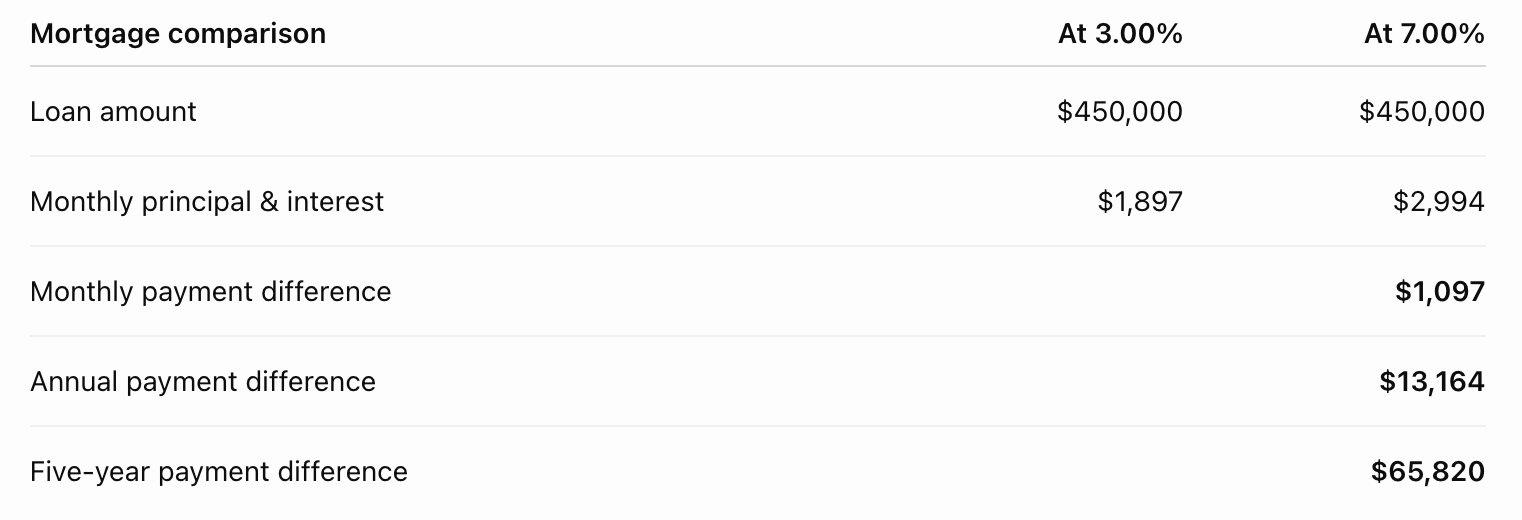
Illustrative comparison using a fresh 30-year amortization for both loans. An actual assumed mortgage retains its remaining repayment term, which changes the payment and total savings. Figures exclude taxes, insurance, mortgage insurance, HOA fees and other financing costs.
That's why an assumable mortgage shouldn't be treated as an obscure financing footnote. A low-rate mortgage can effectively be a valuable financial asset attached to the property. For buyers who can successfully assume the existing financing and manage the remaining purchase requirements, the potential savings can be substantial.
BUT THERE'S A CATCH: THE EQUITY GAP
This is the part that frequently gets left out of social-media discussions about assumable mortgages. Return to our hypothetical $650,000 house with a $450,000 existing mortgage. The difference between the purchase price and the outstanding mortgage balance is $200,000. The seller expects to receive the equity represented by that difference, subject to normal transaction adjustments, and the buyer must determine how to fund it.
The buyer could potentially use cash, proceeds from selling another property, permitted gift funds or secondary financing allowed by the applicable loan program and lenders. This is why the remaining mortgage balance can be just as important as the interest rate. A house carrying a 2.75% mortgage sounds phenomenal, but if only $200,000 remains on the mortgage and the house costs $700,000, the buyer has a $500,000 equity gap to solve. Conversely, a seller who purchased relatively recently with a low-down-payment FHA or VA mortgage might still have a substantial low-rate balance, creating a much more interesting assumption candidate.
The ideal opportunity combines a low interest rate, substantial remaining mortgage balance, manageable seller equity, an attractive property and a qualified buyer. Finding that combination is the real challenge—and potentially the real opportunity.
WHY COLORADO COULD BE PARTICULARLY INTERESTING
Think about what happened along Colorado's Front Range during 2020, 2021 and 2022. Thousands of buyers purchased homes while mortgage rates were historically low. Colorado also has substantial FHA and VA lending activity, with particularly meaningful VA usage in markets influenced by military installations, including Colorado Springs. Many of those owners aren't selling because they dislike their 3% mortgages. Quite the opposite. Their low-rate mortgages are one reason they haven't wanted to move, a phenomenon economists call the mortgage-rate “lock-in effect.”
But life eventually overrides interest rates. People relocate, families grow, owners downsize, jobs change, couples marry or divorce, people inherit property and military families receive new assignments. Eventually, some homes carrying exceptionally favorable financing come back onto the market. And when they do, we want to know what's attached to them. The possibility of acquiring both an attractive home and a below-market mortgage deserves serious investigation.
DON'T EXPECT EVERY MLS LISTING TO TELL YOU
Some listing agents prominently advertise “Assumable FHA Loan” or “VA Assumable Mortgage,” sometimes even mentioning the interest rate. But many listings don't emphasize the existing mortgage at all, and that doesn't necessarily mean an assumable loan isn't present. Searching only for the word “assumable” can therefore miss potential opportunities.
We can look for clues such as the seller's original purchase date and price, FHA or VA financing associated with the purchase, recorded mortgage and deed-of-trust information, original loan amount, likely mortgage vintage, estimated seller equity, MLS remarks and public records. These clues don't establish that an assumption is available or confirm the actual interest rate, but they can help identify properties worth investigating through direct communication with the listing agent, seller and loan servicer.
THE PRIMETIME ASSUMABLE-MORTGAGE SEARCH STRATEGY
This is where working with an experienced buyer's agent becomes particularly valuable. Instead of simply searching for homes between $600,000 and $750,000, we can add another dimension: find homes where the existing financing itself might create value. Our process begins with the buyer's normal requirements—location, price, bedrooms, bathrooms, schools, condition and lifestyle—because a great mortgage doesn't make the wrong house the right house.
Once we've identified suitable properties, we investigate existing financing using purchase history, recorded loan documents and other available information. When a property's history suggests FHA or VA financing originated during the low-rate period, we can estimate the remaining mortgage balance and calculate the potential equity gap. We then compare a conventional new mortgage against the economics of assuming the existing mortgage, including any cash or secondary financing required.
If the preliminary numbers look promising, we work to verify the actual loan terms, assumption eligibility and servicer procedures before relying on them in an offer. The buyer must qualify under the applicable requirements, and the servicer must approve the assumption. Finally, we evaluate how the financing opportunity affects the property's overall value and how best to structure a competitive offer.
The important number isn't simply the interest rate. It's the total economic result.
COULD A BUYER ACTUALLY PAY MORE FOR THE HOUSE AND STILL COME OUT AHEAD?
Potentially, yes. Imagine two comparable homes: Home A is priced at $625,000 and requires new financing around 7%, while Home B is priced at $650,000 but carries an existing assumable mortgage at approximately 3%. At first glance, Home A appears to be the better deal because it costs $25,000 less. But depending on the assumable balance, remaining loan term, financing costs and how the seller's equity is funded, Home B could potentially have more attractive monthly economics despite its higher purchase price.
That's a powerful shift in how buyers evaluate properties. Instead of looking exclusively at the asking price, we should compare the full cost of ownership, including principal, interest, taxes, insurance, HOA fees, mortgage insurance where applicable, cash required at closing and the longer-term cost of financing. A lower mortgage rate doesn't automatically make a more expensive house the better investment, but it can materially change the comparison.
THERE ARE RISKS AND LIMITATIONS
Assumable mortgages aren't magic, and buyers need to understand their limitations. The loan must actually qualify for assumption, the buyer must satisfy applicable underwriting requirements and the servicer must process and approve the transfer. Assumptions can take longer than conventional transactions, while the seller's equity gap may require substantial cash or additional financing at a higher interest rate. VA entitlement considerations can complicate the transaction, and the existing loan's remaining repayment term can significantly affect the monthly payment and total savings.
Buyers also need to remember that property taxes, homeowners insurance, HOA expenses, maintenance and repairs don't become cheaper simply because the mortgage rate is low. And while the interest rate may be attractive, the property still needs to be evaluated for condition, location, resale prospects and long-term suitability. Never buy the wrong house just because it has the right mortgage.
THE OTHER RISK: WAITING
Buyers understandably hope mortgage rates will decline, and eventually they may. But consider what could happen if rates fall substantially. The buyer who has been waiting notices—and so does everyone else. More buyers could enter the market, multiple offers could return, seller concessions could shrink and negotiating leverage could disappear. Home prices might also respond to increased purchasing power, offsetting some of the benefits of lower financing costs.
Nobody knows exactly how those variables will play out, which is why we don't believe buyers should try to perfectly time mortgage rates. Instead, we believe they should look for opportunity within the market that exists today. For some buyers, that might mean negotiating seller concessions or a rate buydown. For others, it could mean finding a home with a favorable assumable mortgage. The best strategy depends on the buyer's financial circumstances, housing needs and available inventory.
THE PRIMETIME PERSPECTIVE
The real-estate industry has traditionally trained buyers to search by price, location, bedrooms, bathrooms, square footage, schools and lot size. Those criteria remain essential, but we believe today's market demands another important question: What financing is already attached to the property?
A home isn't merely a structure and a piece of land. In some cases, it may also carry a financing advantage created during one of the lowest-interest-rate periods in American history. Finding those opportunities takes more work, and not every assumption will make sense. Not every seller will cooperate, not every buyer can solve the equity gap and not every 3% mortgage is attached to a home worth buying. But when the property, mortgage balance, interest rate and buyer's financial position align, the savings can potentially be extraordinary.
At PrimeTime Homes, we're interested in helping our buyers explore every reasonable opportunity—not simply showing properties that match their search criteria. That means looking beyond the listing price, investigating potential financing advantages and evaluating creative strategies that may improve the economics of homeownership.
So instead of simply waiting and hoping mortgage rates fall, let's find out whether the mortgage you've been waiting for is already attached to the house you want to buy.